WARNING: This is a bit of a history lesson. I got a bit carried away!
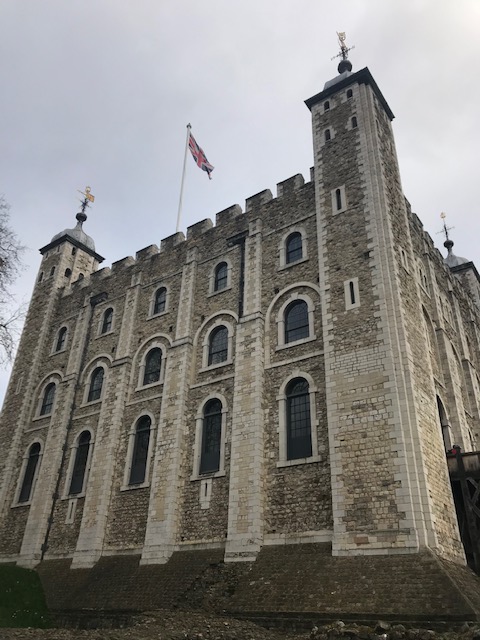
(2-4)– Instead of class, we started off the day by going to see the Tower of London. The first sight we see is Tower Bridge, originally the only way to cross the River Thames. Ornate and hulking, its blue and gold accents complement its surroundings, such as the murky waters of the rivers and the grey sky. The nearby castle, however, built in 1078 by William the Conqueror, has one of the most colorful histories of any building in London.
It first served to protect William from rebellion and stood as a symbol of power over the defeated Londoners; it has been growing along with its history ever since. The White Tower, the central and largest of the towers, began construction in the 1080s. After these Norman kings, Henry I placed the first prisoner, Ranulf Flambard, Bishop of Durham there as a “guest” in 1100. The next year, after hosting a banquet at the Tower, in which the guards were invited and subsequently became drunk, he easily escaped.
In 1191, the Tower was sieged for the first time but was eventually restored to the monarchy; King John took up residence there by 1210. By 1199, the Royals had established a Menagerie from the diplomatic gifts of other nations. Probably starting with two boatloads of exotic animals from Normandy, it too would continue to grow over the ages; lions and tigers became the most favored gifts, symbolic of the royal families crest. It was around this time that a moat was added and became a cesspit, causing illness and friction between the city dwellers and the king.
By Henry III’s time, in 1216, the Tower was reinforced and continued its growth. In 1241, the Welsh Prince Gruffydd ap Llywelyn was imprisoned and fell to his death trying to escape; in 1251, the Royal Menagerie added a polar bear as a gift from the King Haakon of Norway, which was allowed to swim and fish in the Thames once a day while heavily chained. In 1255, King Louis of France also sends an African elephant to join the growing zoo, but it dies a short while later (whether the cause of being ill-equipped to the English weather, cramped conditions or its diet of red wine and cake). A much later addition, an ostrich, also died after being fed iron nails– it was commonly believed that these birds could easily digest such material.
In 1303, The Crown Jewels made their way from Westminster Abbey to the fortress, which began serving another purpose– as a treasury– in addition to its reputation as a prison, a palace, and a zoo.
In 1324, Roger Mortimer (Earl of March) led an uprising against King Edward II. He was held in the Tower but escaped with his lover and Edward’s wife, Isabella of France. These two were thought to have orchestrated Edward II murder, and would later rule over Edward III. When Edward III came of age and was crowned, Mortimer would be hanged in 1330.
Within the decade, the Black Death passed through Europe. The moat was drained as a health concern. Richard II and the Tower in 1381 came under siege and became a shelter during the Peasant’s Revolt, where a poll tax instigated two days of revolt. Simon of Sudbury, the Archbishop of Canterbury, is brutally dragged out of the tower and beheaded at the permanent scaffold on Tower Hill.
Many years passed, in which religion and war caused much discord. The War of Roses (1470) found infighting between the royal “families.” Edward IV dies in 1483, and his son, Edward V, is sent to be crowned king– but before he can actually be coronated, is intercepted by his uncle and Lord Protector, Richard III, and brought to the Tower. Later, Edward’s brother Richard joined him at the castle, but within the year The Little Princes in the Tower had disappeared and Richard III had assumed the throne.
In 1485, the order of Yeoman Warders– known as beefeaters, possibly because of being paid in beef, or because they were allowed to eat at the King’s table– was organized and founded.
In 1509, King Henry VIII marries Katherine Of Aragon, and in 1512, the first chapel burns down in a fire but is rebuilt within two years. Executions, such as that of Edmund de la Pole, is occurring regularly. In 1533, Henry breaks from the church and creates quite a stir when he marries Anne Boleyn. Her coronation begins from her lavish rooms at the Tower; unfortunately for her, she would be back through the Thames Traitor’s Gate in three years and tried for treason, adultery, and incest. She is executed (by a French swordsman, being terrified of axes) on Tower Hill, and Henry remarries.
In 1541, Margaret Pole, Countess of Salisbury, is executed in the Tower, and a year later, the current queen (Catherine Howard) is also executed for adultery. Edward V executes Thomas Seymour (the former queen’s lover) in 1548 and the Duke of Somerset in 1552; Edward dies of tuberculosis. Two years after that, Lady Jane Gray, the ‘nine-day queen’ is imprisoned and later executed, and Prince Elisabeth (later, Elizabeth I) is also held captive.
By 1603, James I takes control; he sees a failed usurpation in the Gunpowder Plot of 1605 by Guy Fawkes, in an attempt to blow up Parliament. Fawkes is held and tortured. In 1618, Sir Walter Raleigh is held in the Tower for 13 years, is released for a while, but is ultimately beheaded.
Between 1649-1659, the Cromwells controlled the castle. In 1660, Charles II is recrowned. The use of the Tower as a prison begins to decline; in 1660, the first sightseers came to visit the Tower to see the Crown Jewels, and in 1671, an attempt by Colonel Thomas Blood was almost successful in stealing them. The Tower avoids destruction in the Great Fire of London in 1666. In 1696, Issac Newton is appointed warden of the Mint.
In 1780, the Tower holds its first and last American prisoner, former president of the Continental Congress, Henry Laurens. The last hanging takes place on Tower Hill in the same year.
In 1804, the Menagerie is opened to the public, but over time begins to decline, and patrons began to realize it’s dangers after several injuries. By the 1820s, the Menagerie had only a small number of animals remaining, but Alfred Cops, a new keeper, brought with him a brief revival, adding 250 more animals to the Tower. In 1834-5, however, the Menagerie was forced to leave the fortress, and the remaining animals were sold to travelers and mostly taken to the brand new London Zoo in Regents Park.
The Tower plays a role in both World Wars and suffers some bombing. 11 German spies are executed, and a Nazi Deputy is even held there, for a time.
In 1952, the last two prisoners, notorious gangsters Ronnie and Reggie Kray, were held at the Tower.
Today, the Tower serves as a home for the Warders, and as one of the most well-known tourist attractions of London. It still houses seven well-fed ravens, based on the superstition that if they were to ever leave the castle that the King and all of England would fall. Its illustrious history serves as a reminder of the past, and stepping inside its heavily fortified gates is a blast. Although I can’t say I saw any ghosts (like that of Anne B., The Lost Princes, or even a large bear said to scare visitors to death), you certainly can feel the weight of the place, of all those who lived and died around you. There is something almost like magic in that crossing of time–perhaps it is the voices of those Kings and Queens, of those killed, of those merely surviving, reaching out and whispering, begging not to be forgotten.
Read more, here, here, and here.
Cheers!




 Ethan Knox
Leave a comment