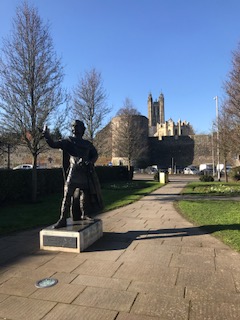
(2-6)– We started off the day with an early morning, 8:30am bus ride. Per usual, we were all pretty tired but in high spirits. We also all made it downstairs on time, which was a problem on the first day. After boarding the bus, we settled in for an averagely long ride through the English countryside (about 2 hours). It took us a hot minute to leave the city– it’s so strange because the city is not that large, and yet the traffic can take hours– but once we did it was a beautiful view. The gentle, rolling hills and the sun rays cresting their way over the top looked fresh out of a movie. Every couple of miles, a group of sheep or horses in their paddocks and fields actually even reminded me a bit of home.
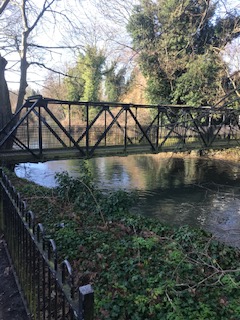
When we arrived, we parked the coach and had a lovely little walk into the main section of the city. Since Canturbury is located on the River Stour, several canal-like streams weave their way through town (Canturbury, for its cathedral, was actually classified as a city, although the population is closer to that of a town).
The first interesting thing we passed was the Crooked House of Canterbury. Officially known as Saint John Boys’ House, the building itself is stable thanks to a beam holding it in place. If you’re a fan of places like these, like I am, it’s just the right amount of old, interesting, and dusty– it currently houses a bookshop that supports the homeless members of the city. Above the door is the Dicken’s David Copperfield quote “A very old house bulging over the road…leaning forward, trying to see who was passing on the narrow pavement below…” 
Then, we decided to grab a quick bite to eat and found a nice little food truck called Cité Crepes. We ended up getting a sugar and lemon crepe and a cinnamon sugar crepe that I made Gianna try; she didn’t like it, but more for me (sweet and sour makes the perfect combination, let me tell you).
And then my final stop before the main attraction was a quick pop-over to the Free Library & Museum, where, in addition to the stacks of books I love, a number of artifacts and paintings lie in an attached annex. I loved walking through the rooms– one, full of portraits, another full of taxidermied creatures, and still another with the cultural fossils of communities past.
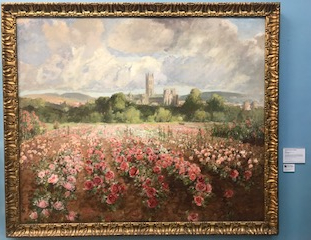
My favorites, though, were definitely the oddities of the collection, such as the stamp prints, a portrait two times my body length of a cattle bull, and a scene titled “it was the time of roses” by David Murray (1914). The piece is an oil on canvas impressionist-style, looking at Canterbury Cathedral from the perspective of Forty Acres Rose Gardens in St. Dustan’s, Canterbury. It was inspired by this poem, by Thomas Hood:
It was not in the Winter
Our loving lot was cast;
It was the time of roses—
We pluck’d them as we pass’d!
That churlish season never frown’d
On early lovers yet:
O no—the world was newly crown’d
With flowers when first we met!
‘Twas twilight, and I bade you go,
But still you held me fast;
It was the time of roses—
We pluck’d them as we pass’d!
Back in the 7th century, Canterbury was only known as the pagan country of Kent and contained remnants of an earlier Roman settlement– such as the huge wall still surrounding sections of the city today (It’s surprisingly Vaticanesque!)
In 597, Pope Gregory the Great sent St. Augustine (an Anglican monk seen today as a Founder of the Church) to Kent, to convert their king, Æthelberht, and his wife, Bertha, to Christianity. When Augustine succeeded, Æthelberht donated some of his lands to the Church, and it is here that Canterbury Cathedral stands. Augustine was made the first Archbishop of Canterbury, and the building became the first Anglican cathedral.
Over the ages, the cathedral would suffer losses and change drastically with invasion and natural disasters. It remained a popular and important pilgrimage site, as well as a cultural institution. However, it took on its current form and added importance in 1170 when Thomas a Becket, the then archbishop was murdered, inside the church, after disputes with the king. It is thanks to the shrine and the miracles which many said the soon-after canonized saint’s body could perform that brought people to the church and solidified its importance. In fact, The Canterbury Tales, Chaucer’s masterwork, would not be possible without it. Beyond fiction, it’s almost impossible– and humbling– to imagine how many people passed through the gates and walked into the crypts and buildings to see the same thing that we were seeing; nothing is quite so shocking as knowing that people from all walks of life, in sickness and in injury, came here to pray and be healed.
On a more surface level, beyond its importance as a religious site, the building itself is also stunningly beautiful. It’s a UNESCO World Heritage Site, and it’s well-deserving of the title: gothic arches, colorful stained glass, and open space that echoes the sound of footsteps: it all sends you back in history. Although Becket’s body has been lost, there are still tombs inside, including that of Henry IV, and those give the place an air of importance, similar to the way graveyards make you feel their weight.
As a day trip, it was so worth it to see this city. I felt the change from the big city to small, and the subtle change in pace made everything take on more meaning. Besides the traffic that took us an extra two hours on the way home, it was almost relaxing to be there; everything took on a loftier meaning. I could feel myself moving through the centuries, and the beauty of the place was the same kind of beauty I connect to in museums.
LONDON JOURNAL ASSIGNMENT:
- You can see the cathedral from most parts of the city if you look hard enough, and the buildings don’t match
- Streets are cobbled and yet somehow most people are quiet and don’t click– it’s peaceful here. Even the dogs seem to step softer
- There are like a thousand different kinds of dogs (bull mastiff, terriers, cocker spaniels) wandering the streets but everything is a lot cleaner than you’d expect
- The homeless people don’t “beg” like they do in the U.S., but people seem more compassionate about it, and a lot of shops donate/ a lot of people help them
- Churches and flower gardens go together– also a lot of churches but little to no people in religious garb
- People look at you but don’t smile out of guilt/neccesity–> what you see is what you get
The streets are silent and shaded; the buildings bulge out into the road like the round coronas of eyeballs. Their windows are like lenses and the Tudor style houses make up the contours and shapes of human faces. The cobbled streets are mouths that gap and wind and swallow people whole. And they’re different but so close to the same that moving through them is an almost maze-like intricacy, a worrisome whisper that you could get lost in these quiet halls capped with the deep blue of a cerulean sky. It is almost shocking when the spires of yellowed marble break into the skyline and ask for attention, trying to graze the blue with their spires. It is a shocking thing indeed that the faces are almost all turned away, turned inward and whispering to each other and peering at the ground. And the people barely seem to notice beyond those peering faces, walking up and down their paths like rats in a maze, going, going, gone around the bend, and never look up and see the single building, always visible but just out of sight, holding up the sky.
There are so many flowers waiting to bloom that it almost feels like a painter has left off partway through. By spring she will be back with her brush and mark the fertile ground and bushes with so many colors it could make your head spin. They line the grounds of churches that are painted with sharp lines and hard brushes, obsessively constructed and made to fit an ideal image. They make the sky seem too simple and the grass too green, but the painter is said to have got the churches right, from their arches and towers to their marble or brick. They are all so different, except for their gardens, which all wait to bloom, passing a winter that doesn’t feel like winter at all. Does the painter see the buildings of times past and wonder at their beauty, or does it lay within the natural, the flowers which fill their gardens? Does the artist yield to the ideas of opposition– is a church a church without flowers to make it whole? Where does reality start and end? Are we the pilgrims, looking for the answers in the folds of history and dirty, unswept corners of churches? Does the stained glass inspire in us the sublime or merely the idea of it, the need for some greater purpose? Where does art end and life begin?


 Ethan Knox
Leave a comment