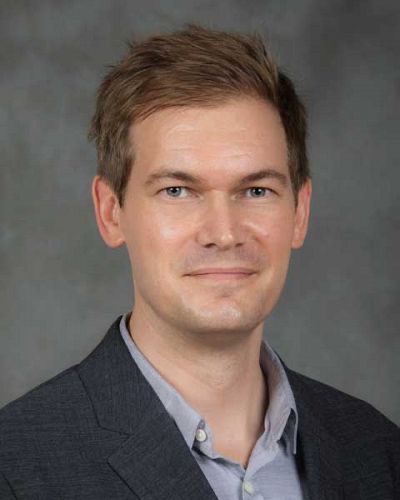
Kenneth White believes that experimental cinema is an opportunity to both engage with a piece of work and find out how the world he lives in is shaped by the arts.
“I often begin with a question that is in response to a work,” said White, an assistant professor in the Cinema Department at Binghamton University. “‘What am I looking at? What do I hear and how is this presented to me?’ Very basic questions. I seek to develop a direct description of an experience. It’s from that direct and apparently plain language that the complexity and nuance of a work can arise.”
White focuses on experimental and avant-garde film history and theory. While his interests move across media and topics, the tensions of the Cold War and the impact multimedia technology has on our understanding of the world are central to his creations and teaching methods. He hopes that through conversation about works that are typically hard to describe, individuals can learn more about ourselves and the world around us.
“As multimedia projects, immersive media, artificial environments, augmented reality and VR become ever more present within our lived condition, I see it not so much a distinction away from cinema, but rather evidence of an even greater necessity to invest in constructive critical inquiry into the history of cinema and to understand how those tools of the past may in fact open up the future,” White said.
Originally a filmmaker trained in a studio critique environment, White earned his bachelor’s degree in art media studies at Syracuse University. While in college, he worked as a film projectionist, where he saw Dziga Vertov’s 1929 film “Man with a Movie Camera” in 16mm and became interested in understanding the materiality and spirit of experimental cinema.
“Projecting the film and seeing it as a film strip, understanding the film as a series of images that Vertov and his collaborators had organized—you actually watch [them] editing the film that you’re watching—projecting that film for me was a very small way of participating in this revolutionary transformation of the world through cinema,” White said.
From these experiences, he developed a “real hunger for an understanding of my precedents,” and pursued his doctorate from Stanford University in art history and film studies. He also credits his time at the Whitney Museum of American Art Independent Study Program as critical to his understanding of cinema and his development as an artist.
After his own education, White taught at several colleges and became a faculty member of curatorial studies at the Whitney Museum before joining the Binghamton Cinema Department, whose renown he knew well.
“I was always aware of Binghamton and its legendary Cinema Department,” White said. “I was educated about its faculty members and the films they made right from the very beginning of my film school education. It’s been an enormous privilege to be here and it’s really amazing to know that I will be a part of this culture and to have the opportunity to make a contribution of my own.”
White is currently completing a book about the history of American media art during the late Vietnam War era, which he has titled “Hyperventilation Syndrome: Media Cultures, Control Societies—ca. 1970.” It examines film and video made by artists in North America during the de-escalation of the war, and the tensions which these artists felt culturally.
“My goal in this book is to describe the way in which artists were using media technologies as a means of examining our relationship to communication itself in the context of grief, the distress and the anger that distinguishes American culture in those years, a time in which it seemed American life was coming apart,” White said.
White also recently organized the Cinema Department’s presentation of the film “WR: Mysteries of the Organism,” directed by Dušan Makavejev in 1971. At the screening, White unveiled a version of an “Orgone Energy Accumulator,” a device designed in 1940 by Wilhelm Reich as “a kind of fallout shelter against rising fascism.” White spoke about the device’s history as a political and ideological symbol. The Accumulator was built by Peggy Ahwesh, Keith Sanborn, Soyoung Yoon and White in the studios of the Cinema Department where it is still available for all in the Binghamton community to explore and engage with.
Along with his own projects, White served as an editor of two books about the living artists Carolee Schneemann and Michael Snow, where he organized critical perspectives on the artists’ work. Additionally, he edits the Millennium Film Journal, a selective bi-annual collection of cinema criticism, history and theory.
“As a writer and as a scholar I see a certain responsibility to participate in creating opportunities for my colleagues and fellow researchers,” White said. “And I see my work as an editor at the Millennium Film Journal and also editor of books such as ‘Carolee Schneemann: Unforgivable’ and ‘Michael Snow: October File’ as contributions to the dialogue, to the larger conversations of my community.”
White feels that his field can be shaped through educating the next generation of cinema students while listening to their processes and learning along with them to expand their “critical vocabulary and constructive dialogue.” He hopes that through experimental cinema, and the critical eyes that perceive it, new insights into our humanity and the ways we navigate our lives will come to light.
“My efforts in learning through making continue to inform how I organize my courses and how I conduct my teaching. I try to explicate, to open up how an artist makes a work, and through learning about their process, I think we all can perhaps be more sensitive and more aware of how our world is made.”


 Ethan Knox
Leave a comment