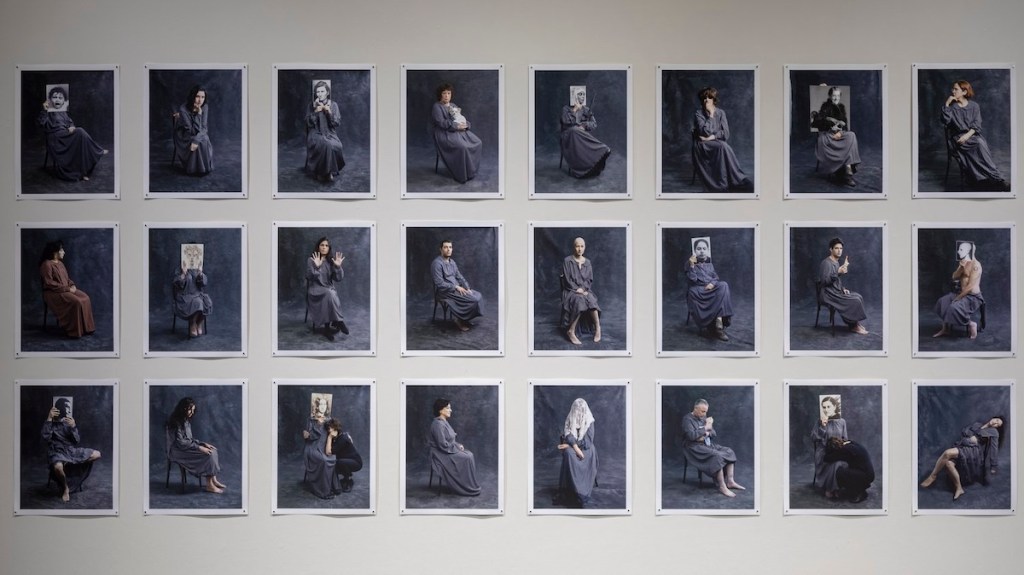
“Michal Heiman: Chronically Linked” was the largest exhibition of the artist’s work in the U.S.
By Ethan Knox ’20 on FEBRUARY 07, 2024 @BingUNews
For many surrealist painters, writers and famous psychoanalysts — Sigmund Freud, most notably — the name “Gradiva” refers to many things: A Pompeian bas-relief, a famous story, and an analysis of dreaming and delusions. For Michal Heiman, the name Gradiva can conjure up two more associations: the photograph of a woman who inspired her art, and the award she received for it.
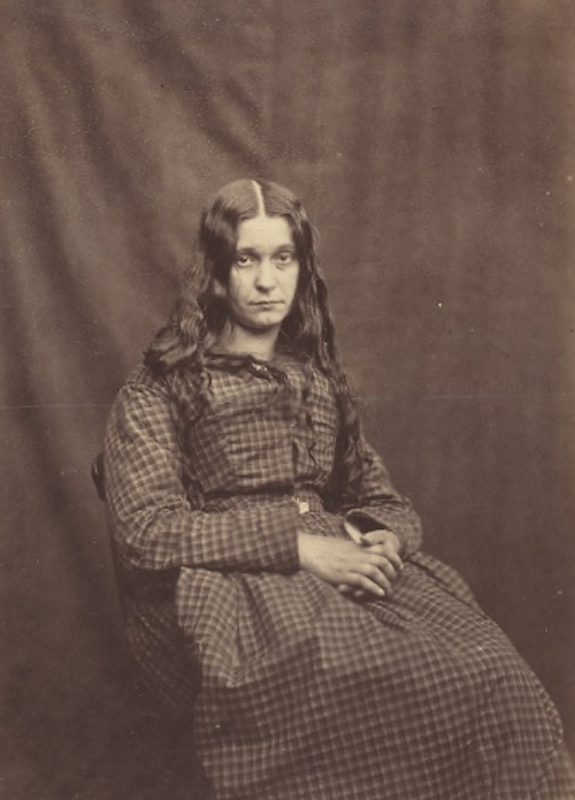
The Binghamton University Art Museum hosted the exhibit “Michal Heiman: Chronically Linked” from Sept. 9, 2022, to Feb. 15, 2023. At its heart was a photograph Heiman discovered of a young woman taken around 1855 at the Surrey County Lunatic Asylum in London.
- Learn more about Michal Heiman at her website.
- Learn more about the Binghamton University Art Museum and its permanent collection of more than 5,400 objects and artworks.
“The photograph completely affected me. It led me to a project seeking to contribute to envisioning the political, cultural, gendered and psychic conditions of women in asylums, and the possibilities of ’return’,” Heiman said. “The strategy of intervening in existing spaces — archives, photographs, films, works of art, historical events, case studies, diagnostic tests — breaking their silence, and using them as a platform for visual enactments and new concepts was not new to my practice, but it was a radical proposal to create a new community, comprised of dozens of photographs of women, asylum-seekers, activists and artists.”
The exhibition recently received the Gradiva Award from the National Association for the Advancement of Psychoanalysis (NAAP). Each year, the organization celebrates and acknowledges works that represent and promote psychoanalysis and psychotherapy.
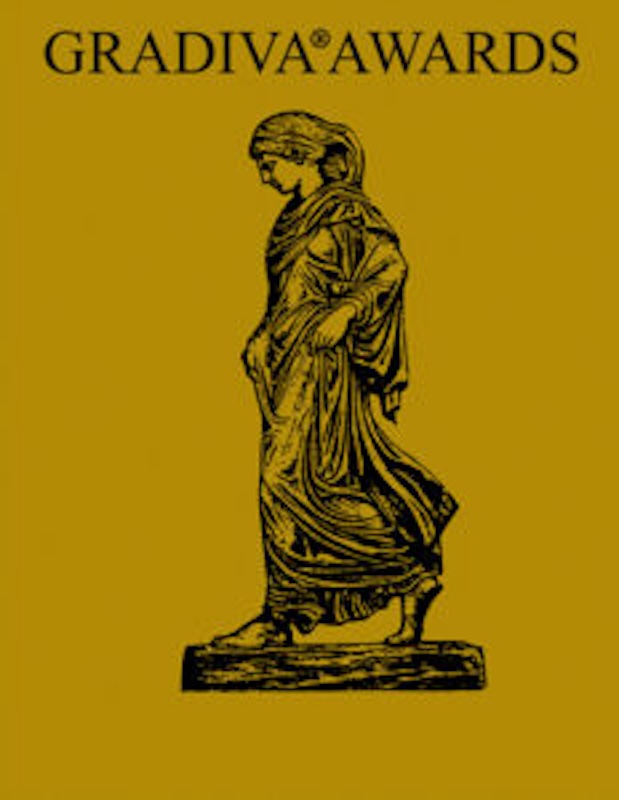
The Gradiva Award was inspired by a Pompeian bas-relief that itself was the basis for the 1902 novel Gradiva by Wilhelm Jensen. It tells the story of a young archeologist who sees the bas-relief in a museum and becomes obsessed with the woman depicted; he goes on to dream of their life together, and one day sees her walking among the ruins. It is revealed that he had previously known the woman, who has dressed as Gradiva to attract his interest. His dreams thus served as an awakening to his real-life love. Sigmund Freud was so arrested by the story that a copy of the relief hung in his office in Vienna.
Heiman and Kovacs used this story in creating the exhibition: With an analyst couch borrowed from the theater department, the pair recreated the effect of the Gradiva relief, but instead replaced the sculpture with the images of the woman which first inspired Heiman’s work, again centering on Heiman’s motif of “return.”
“It’s called ‘Michal Heiman: Chronically Linked’ because her work builds from each new project,” said Claire Kovacs, the Art Museum’s curator of collections and exhibitions. “The show included photographs, video and sound components — and we also borrowed a set piece from the theatre department to round out the installation. As we conceived the show, we thought about how these artworks could exist in this space together.”
Investigating personal experiences and recovered “detritus,” Heiman’s conceptual works are grounded in photography, video and archival materials. Her projects, including “Radical Link: A New Community of Women, 1855-2021” (2013-present) and “Hearing” (2020), all consider the political, cultured and gendered conditions of “return” — both returns to the past and rights of return.
“Heiman’s work as an artist is conceptual. It’s not just a photograph for you to look at that’s very straightforward and you’re expected to draw A, B and C conclusions from it,” Kovacs said. “She means for you to engage with the work from wherever you’re coming from. All of us approach art from different perspectives. In many ways, she’s enacting a psychoanalytic framework in the engagement of the work itself.”
Heiman began her psychoanalyst work in 1994, with the work “Michal Heiman Test: Endopsychic Press,” at the University of Melbourne Museum of Art, Australia. She has continued that series, using her own procedures to administer and enact them in museum and theatre spaces. These installations are known as the Michal Heiman Tests or M.H.T.s, modeled after the Thematic Apperception Test (TAT), in which trained professionals interpret clients’ reactions to plates featuring ambiguous situations.
In these pieces, Heiman challenges and deconstructs these “tests” through her work, believing they can be dangerous tools.
“Essentially, you have somebody who’s trained in the artwork sit down with somebody who’s a volunteer, and they enact that process, like the Thematic Apperception Tests,” Kovacs said. “‘Here’s a photograph: What do you see here? What are your experiences?’ She has a whole framework planned out: that’s the experience of the art.”
“Michal Heiman: Chronically Linked” was the largest exhibition of Heiman’s work in the U.S. and brought together the M.H.T.s and some stand-alone pieces. Before the 2022 exhibition, Heiman had shown these works at the American University Center for the Arts and the Jewish American University.
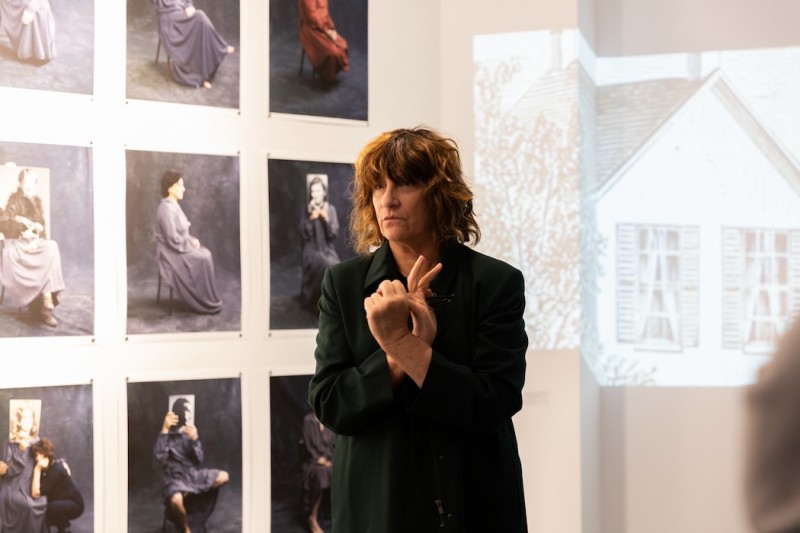
Michal Heiman (she/her/hers) is based in Tel Aviv, and is an interdisciplinary (art)ivist, curator and theoretician. A member of the Tel-Aviv Institute for Contemporary Psychoanalysis, her work features neglected history, challenging photography’s healing potential and its role in human rights, and has been shown in venues such as the University of Melbourne Museum of Art, Documenta X (Kassel), Le Quartier (Quimper), the Museum of Modern Art (Saitama City), The Van Abbe Museum (Eindhoven) and the Museum Ludwig (Cologne).
In 2022, she exhibited Traversing Time and Space at Redbase Art Gallery in Sydney, Australia, curated by Nancy Nan, and participated in reality check chapter II: inner sanctum, at the Psychiatric Hospital of Attica, Dafni, Athens, Greece, curated by Kostas Prapoglou. In 2023, she debuted a new short film, The Wondering Maniac (8 minutes), part of the group exhibition, The Butterfly Effect, at the historic “Petalouda,” Textile Industry on Kifisou Avenue, Athens, also curated by Prapoglou. Most recently, The Centre Pompidou added her installation, The Blind Triptych (2022), to their permanent collection, part of an amazing collaboration between Artis organization and the Pompidou, and it is now being shown as part of the group exhibition, ‘Corps à corps: Histoire(s) de la photographie’ in the Centre Pompidou, Paris, curated by Julie Jones.



 Ethan Knox
Leave a comment