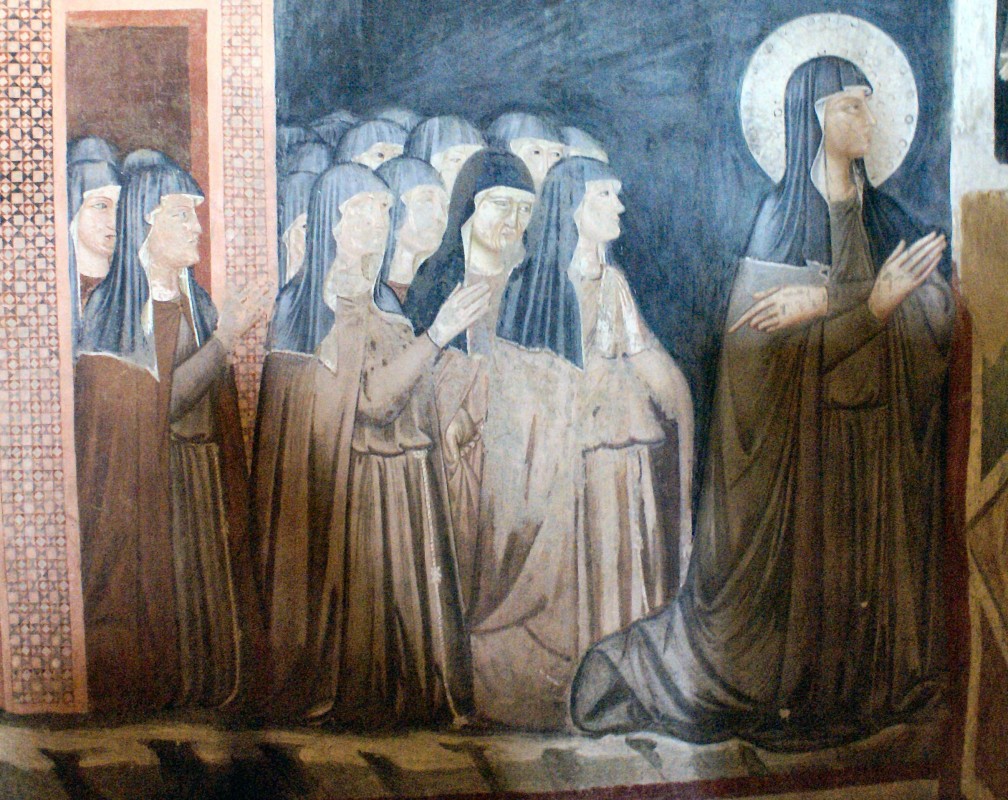
Historian’s research challenges traditional views of medieval women by uncovering their roles in spiritual and political life
By Ethan Knox ’20 on JULY 15, 2025 @BingUNews
Today, it may seem like history is only in the past, but for medievalists like Hannah Jones, it has genuine repercussions that radiate through time. She doesn’t have to look much further than the Supreme Court, which referenced medieval case law in a modern-day decision. But without research, are those events taken out of context?
“Traditionally, when you think about the Middle Ages, it’s a very flat, dark, stereotypical image of society, whereas the reality was so much more complex,” said Jones, who earned her doctorate from Binghamton University in the Spring 2025 semester. “It was much more diverse than just these great men. I think that we can learn a lot about society today by dissecting how these social hierarchies were formed in the Middle Ages. How was power distributed? A lot of the inheritance of women being marginalized in society today is coming out of that framework.”
Originally from a small town in Oklahoma, Jones completed her undergraduate degree in history at Southeastern Oklahoma State University. Her interest in medieval history began with a single book: God and the Goddesses: Vision, Poetry, and Belief in the Middle Ages by Barbara Newman, which synthesized data of different kinds beyond the standard, dry information like census or tax documents.
Jones has worked hard to model her own research after this style. It’s paid off: Her dissertation, “Poor Women of the New Jerusalem: Clare of Assisi, Spiritual Martyrdom, and Female Sanctity in the Later Middle Ages,” won the 2024 Distinguished Dissertation Award from the Graduate School.
Although she hadn’t planned to pursue graduate studies, some prompting from an advisor and her discovery that one of Newman’s students taught at Binghamton motivated her. She faced an early obstacle: Jones didn’t know Latin, a foundational language for a medievalist.
The University stepped in to provide support, which gave Jones the opportunity to attend the CUNY Latin Institute in New York City. Over the following five years, Jones’ applications for additional funding continued to impress: She received a language grant to go to France to study French; a dissertation year grant allowed her a whole semester to study in Italy; and additional funds from Harpur Edge made possible a month in Central Europe.
“I just can’t say enough about how supportive the department has been for this whole journey. It’s a real privilege to have those travel experiences, but to do it in a way that’s supporting my professional development was just amazing,” she said. “Every single door that Binghamton opens just has another door ready to go right behind it.”
The Poor Clares and the Crusades
Jones’ dissertation topic was inspired during her first semester at Binghamton, when she took a class that discussed Francis of Assisi and the religious movement known as the Franciscan Order. She was interested partly because Francis’ theology initially seemed gender inclusive. Yet when she began to investigate, the scholarship on Franciscan women said something different: women were marginalized.
“The records we do have are written from the church’s view, how the people in power want things to be described,” Jones explained. “There are ways to get around those propaganda narratives. I tried to examine sermons, hagiographic texts, liturgical hymns and devotional art, because that’s something that everyday people would have been interacting with in some way.”

ADVISING HARPUR STUDENTS INTERESTED IN LAW
While completing her dissertation, Hannah Jones’ original funding line expired. To continue her research, she accepted a position as Harpur’s pre-law advising associate. She continued in this role after graduation and finds this work especially fulfilling, since many students she works with are also pursuing history degrees.
“Students who are interested in law gravitate toward history because they’re learning foundational research and writing skills, and those are really the cornerstones of law school,” Jones said. “I think that students recognize that they’re getting that in-depth education from the major, and that it will transfer very directly to their next step. I really do try to be a cheerleader for my students.”
Soon, this train of thought led her to Clare of Assisi, founder of the Poor Clares, the Franciscans’ female branch. It was as popular as the male branch, but it often labeled by scholars as less successful because its members didn’t preach, instead taking vows on enclosure.
This led many to view the group as oppressive, but Jones wanted to find out for sure. She began to dig into documents that drew her closer to the often-unwritten female perspective of the time. And what she found surprised her.
“As I started doing the research, I realized Clare is not talked about as marginal at all. She’s this powerful, militant intercessor. She is described as the Queen of Heaven, ‘burning demons with her tears.’ She was said to have expelled a literal army from her town,” Jones said. “She’s not physically out in the community, yet everybody in town knows about her and thinks that she’s spiritually perfect. So that really disrupted that traditional narrative that I was bumping up against.”
The more she investigated the story, the less it seemed like women were second-class citizens. In fact, the Clare sermons — many of which were never before translated — positioned Clare and Francis as a partnership.
Jones also noticed that sources often described Clare as a martyr despite her peaceful death.
“That made me ask what was happening on the ground,” Jones said. “I started mapping the locations of the Clare’s houses, and that’s when I realized — they were putting women into crusading zones in the contested frontier as a strategy for spiritual defense. They have the military organizations and the Franciscans alongside them, and the women are part of this strategy.”
This was a defining point for Jones. She realized that these women were making a conscious decision to go into a vulnerable, violent context. Since they were not allowed to leave the monastery — and their homes were being attacked, as the records show — Jones argues that the women themselves looked to martyrdom as the better option.
“The groundbreaking moment in my project was when I found chronicle accounts talking about Clare nuns who decided to cut off their noses to preserve their chastity. There are intense descriptions of them saying, ‘We want to make ourselves monstrous so that we can be pure for our heavenly husband,’” Jones said. “From a modern standpoint, that’s dark, and that’s not at all what we would call agency, but I think it’s a powerful option for medieval women; they took a vow and this is their avenue for protecting that vow.”
Jones said she likes to think of her research is a new way of examining women’s participation in the Crusades. They may not wield swords on the battlefield, but their prayers are seen as having a protective force. She proves this point with digital resources: using more than 500 points of data, she began to map the homes of Poor Clares, and shows that they were outside the city walls and aligned with the actual frontier zones of Christendom.
“The mapping was a way to bring the human back into the project. I was living in the world of ideas and I needed to ground it. For me, the digital scholarship methodologies have really helped me take the project to that next level,” she said.
Even with the recent completion of her dissertation, Jones is far from done with this work. Next, she says, is turning the project into a book with an academic press.
Like her inspiration, Barbara Newman, Jones hopes this work will inspire others to follow their passions, reevaluate their source materials and challenge the way you think about the world today.
“If you’re only looking at the main historical documents, that deeper level of how everyday people are interacting and their memory is lost,” Jones said. “Knowing this historical context allows you to be a more empowered citizen. When you’re hearing propaganda, you can say, ‘This is misusing and abusing the past to create a particular portrait of society that never really existed.’ We need the premodern world to better understand where we’re at in modernity.”

 Ethan Knox
Leave a comment