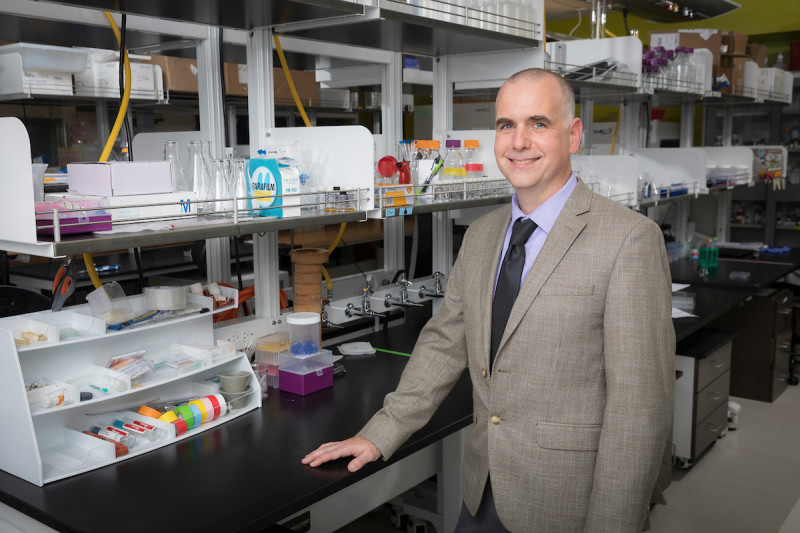
Pharmacy faculty works to develop antibody-drug-conjugate technology
By Ethan Knox ’20 on APRIL 23, 2026 @BingUNews
A leading expert in antibody-drug-conjugate (ADC) technology, L. Nathan Tumey has worked for nearly two decades developing new approaches for the treatment of cancer. Now, thanks to a substantial $2.75M grant from the National Institutes of Health, Tumey is taking an exciting step forward in his research — leading the charge to transition this exciting technology platform for applications outside of oncology.
“The majority of my focus has been on cancer by default, because that’s where ADC technology was initially validated,” said the assistant graduate director, vice chair and associate professor of the pharmaceutical sciences program. “But with this new grant, we are taking a more ‘indication agnostic’ approach, developing new chemical technologies that will push the boundaries of what can be accomplished with ADCs.”
Tumey was recently awarded the Maximizing Investigators’ Research Award (MIRA), an R35 grant that provides broad support for technology development. The goal of MIRA is to provide investigators with greater stability and flexibility than traditional “specific aims” driven research grants, thereby enhancing the chances for important breakthroughs.
“Typically, we develop a large set of preliminary data, and the NIH says, ‘We’re going to provide funding so that you can see this project through to fruition,’” Tumey said. “However, the MIRA mechanism instead looks back at our past research track record, providing flexible funding that allows us to continue proposing these new, innovative designs without being limited to a pre-developed specific aim.”
Beyond traditional technology
The spark that began this project began with Tumey’s previous antibody-drug-conjugates research, which has primarily been used as a targeted chemotherapeutic agent, to deliver cytotoxins to cancer tissue. Tumey envisioned that the technology could be useful for delivering things other than traditional cytotoxins – ultimately modulating cell signaling pathways rather than simply killing cells.
In his first research focus, Tumey’s lab is developing technology for attaching multiple payloads to a single antibody. Together, they believe that the pair of payloads will perform better than either could alone, otherwise known as “synergistic activity”. One class of drugs that his team is focused on is to awaken tumor-associated immune cells in that tumor micro-environment, which can recognize the cancer as something foreign.
“Our hope is that the immune system becomes reprogrammed and prevents cancer regrowth,” Tumey said. “We combine the immune agonists with a cytotoxin that slows tumor growth, but in the long term, we rely on activation of our immune system to keep the cancer at bay.”
Building on his interest in immune-modulation, Tumey is also working to selectively deliver immunosuppressive agents to cells driving autoimmune diseases like rheumatoid arthritis or lupus. These immunosuppressive agents may be further combined with an entirely new class of catalytic payloads, called organometallic catalysts.
Rather than inhibiting a biological pathway in a cell, these catalysts can deliver an entirely new function to a cell. For example, this could mean degrading a reactive oxygen species within a cell, and reducing or eliminating the cellular damage that the oxygen species is causing during inflammatory events.
“You can think about it like enzyme replacement therapy,” he said. “But there are huge limitations with those approaches, because those enzymes get degraded by the body. They’re often immunogenic, which means the body rejects them. They can’t get into cells. In contrast, these organometallic catalysts can be sent directly to nearly any cell type that we want to target.”
The path to innovation
After working for many years in the pharmaceutical and biotechnology industry, Tumey came to Binghamton University’s School of Pharmacy and Pharmaceutical Sciences in 2017 with an opportunity to helm an independent research lab. He had several reasons, but among them was greater freedom to explore these passionate interests, a bargain that has paid off in this MIRA grant.
“I was excited about the ability to have the freedom to explore therapeutic ideas without the limitation of commercial success always hanging over your head. In the pharmaceutical industry, you can research whatever you want — so long as it’s going to make lots of money. But there is a lot of amazing science that can be done in areas where the commercial value is not immediately apparent.”
At Binghamton, Tumey said, administration and faculty are fully committed to rigorous biomedical research — even in areas where there isn’t a near-term commercial value. For example, the pharmaceutical industry has tremendous skepticism about immune-modulating antibody conjugate technology — and has been largely unwilling to invest in its development. His academic position at Binghamton has enabled his lab to conduct efficacy and safety studies to understand both the potential and the risks of this new technology. Tumey hopes that this research will show that these immune-modulating approaches have clinical potential.
Currently, Tumey’s lab continues to collect raw data and looks forward to moving on to the next phases, with a long-term goal of clinical trials. All along, he hopes to continue celebrating the success that being at Binghamton has made possible — from the support of leadership, who have created a department where innovative projects and partnerships have become natural, to the dedication of his students, past, present, and future.
“My success in getting this grant is built on the hard work of my students — both graduate and undergraduate — who have spent countless hours in the lab developing the dataset to support the patents and publications that we’ve submitted over the last number of years,” Tumey added. “I’ve had the pleasure of working with some amazing students at Binghamton, and we’ve published about a dozen articles over the last seven years. Without those publications and preliminary data, this grant never would have been funded. I am so grateful to be a part of an organization and a department that is so supportive of innovative science.”

 Ethan Knox
Leave a comment