Program provides students a look at care challenges and encourages future careers serving underserved communities across New York
By Ethan Knox ’20 on JUNE 01, 2026 @BingUNews
Rural New York makes up about 87 percent of the state’s land area, according to the New York State Senate(opens in a new window), and more than 3.5 million people call it home. In the North Country, an area of 11,000 square miles where residents are older and have a lower household income than other New Yorkers, the number of healthcare professionals and the number of available beds are significantly below the average(opens in a new window), creating significant healthcare disparities and a decline in quality care.
Meanwhile, the college experience can be insular; real-life practice opportunities, especially in healthcare settings, can be hard to come by. But The Rural and Underserved Services Track (TRUST) at Binghamton University is working to change that, while helping immerse students in rural environments like the North Country.
“What we heard from students who participated in the Rural Health Immersion Program was that there is nothing quite like seeing work on the ground happening, to be at dinner with your peers debriefing, or to be alongside a doctor or a social worker as they’re delivering hard news to a patient,” said Jackie McGinley, associate professor and TRUST assistant director. “For the students, this brought alive everything that they’ve been learning about.”
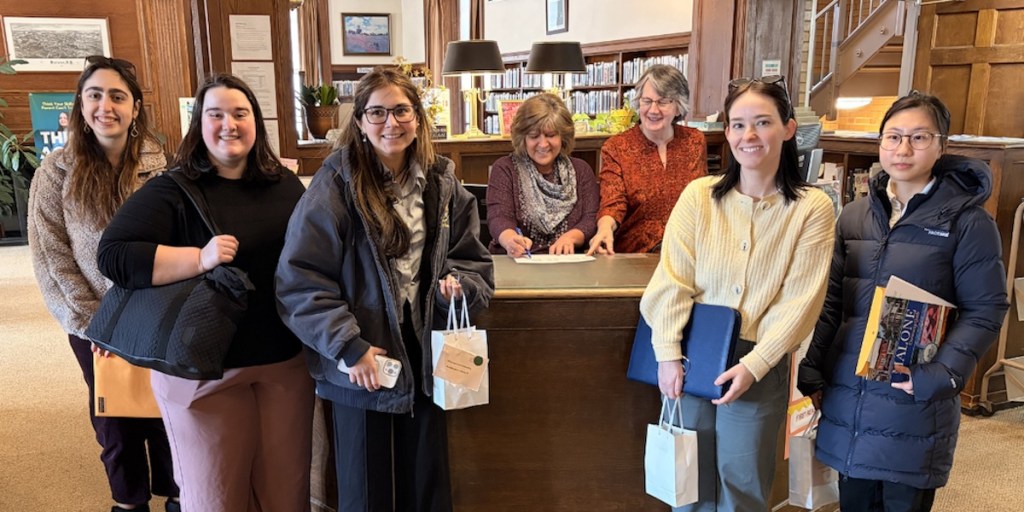
TRUST conducted a Rural Health Immersion Program at Alice Hyde Medical Center in Malone, New York, from March 29 to April 3. Developed and planned in collaboration with the Northern Area Health Education Center (NAHEC), Central New York Area Health Education Center (CNYAHEC), and Alice Hyde Medical Center, the program introduced students to healthcare in a rural community.
The primary goals were to help the five participating students gain an understanding and appreciation of rural healthcare settings, including their benefits, barriers, opportunities, and challenges; get students interested in a career in rural medicine and healthcare, a high-need area; expose students to a variety of different healthcare professions; and provide an opportunity for students to develop and demonstrate professionalism, presentation skills, and service.
“The program is incredibly well aligned with the learning objectives of TRUST. It embeds students in the community, giving them interprofessional exposure both with their own peers and also professionals in different healthcare and community-based settings,” McGinley said. “We’ve made a concerted effort to expand the type and number of service activities TRUST offers, and this was an important year to pilot this immersive experience.”
A week in Malone
Students spent a week immersed in the Malone community, shadowing and interviewing healthcare professionals at Alice Hyde throughout its many professional areas, and completed the program by reporting the results of their findings throughout the week to hospital administrators, providers, and community members.
Kiana Tanghatar, a second-year doctoral student in the Community Research and Action program, was a participant in the program. Her background is in speech therapy, but she decided to broaden her scope to see the bigger picture of healthcare. She’s interested in working with multilingual families and decided to pursue a multidisciplinary program, learning how to do community research and serve special populations to expand her skillset.
She said that her experience in Malone taught her that access issues aren’t just about the providers’ existence, but their proximity. Transportation was a common problem. Even so, she saw a possible benefit to rural care — compassion.
“This experience showed me that, even in the face of challenges, providers play a critical role in shaping how people experience healthcare,” Tanghatar said. “The most interesting thing for me was the level of empathy that providers showed. Everyone whom I spoke with was genuine about working with their patients and going above and beyond to meet needs.”
Parts of the program included a panel with regional health service providers to discuss their roles in the community as well as their views on rural healthcare. To give students an overview of some of the services offered in the Malone area, they also participated in a scavenger hunt. At each location, students interviewed an agency representative to better understand the function of that agency, as well as how the individual saw their community — from its benefits to its challenges — and what they look for in a future healthcare professional.
Students also conducted surveys to identify community healthcare issues and concerns.
“The faculty reshaped how we think and how we look at rural communities,” Tanghatar added. “Every day, we had a debrief, where we shared our experiences — what surprised us today? What did we learn in shadowing? And the faculty also shared their own experiences, coming from different fields. It really helped me to look at healthcare from different lenses, beyond my scope of practice.”
Tanghatar said that overall, this program was an opportunity to pause and analyze her path and the broader healthcare system, which is rare in a busy schedule. She still has two years left in her doctorate, but she hopes to take her experiences from TRUST and work in academia to help students gain experience hours in rural settings as supervisors or mentors.
Investing in the future
Tina Andrews-Perry, Alice Hyde Medical Center student and volunteer services manager, was responsible for all the student placements during the rural immersion. She herself started at Alice Hyde 14 years ago as a volunteer, where she discovered a passion; since then, she has helped host around 300 students a year.
She sees the Rural Immersion Program, and curricula like it, as an investment in the future. Providing clinical hours and experience to students ensures that there will be providers in the future who have dynamic views of healthcare.
“Several of the students come in, and they’ve only been in their own field. What I try to create is the full picture,” Andrews-Perry said. “There’s a lot to patient care beyond bedside care. I try to give students a full overview of healthcare and how closely we all work together.”
She also feels that the experience works from both sides. Preceptors and providers learn something along with the students — how to stay current and teach others about their unique outlooks.
“I cannot understate how much work our colleagues at Alice Hyde Medical Center did to make it possible for each student to have such a meaningful and unique experience, especially because they couldn’t just put them on one unit with one discipline,” McGinley said. “They had to find individualized placements for each student, and I think that was such a strength of this experience. As a faculty member, I got to see, and the students were able to experience, interprofessional practice in such a dynamic way.”
Upon completing the immersion, the coordinators hope students will better understand the management and services of a rural critical access hospital, as well as the challenges people may face in obtaining these services. Through qualitative study, they assessed the relationship and communication between the community and the hospital to think critically about solutions.
AHEC has since secured additional funding that will allow the program to expand next year. Overall, the TRUST program looks forward to offering this opportunity again after its success.
“The experience was very positive from all sides. Immersion holds so much value. We’re currently exploring if there’s other immersive experiences we can offer to TRUST scholars; we’re also hoping to strengthen and expand the number of partnerships,” McGinley said. “This was just a wonderful experience, and I hope we’re able to do it again, because we’re just getting started.”
 Ethan Knox
Leave a comment