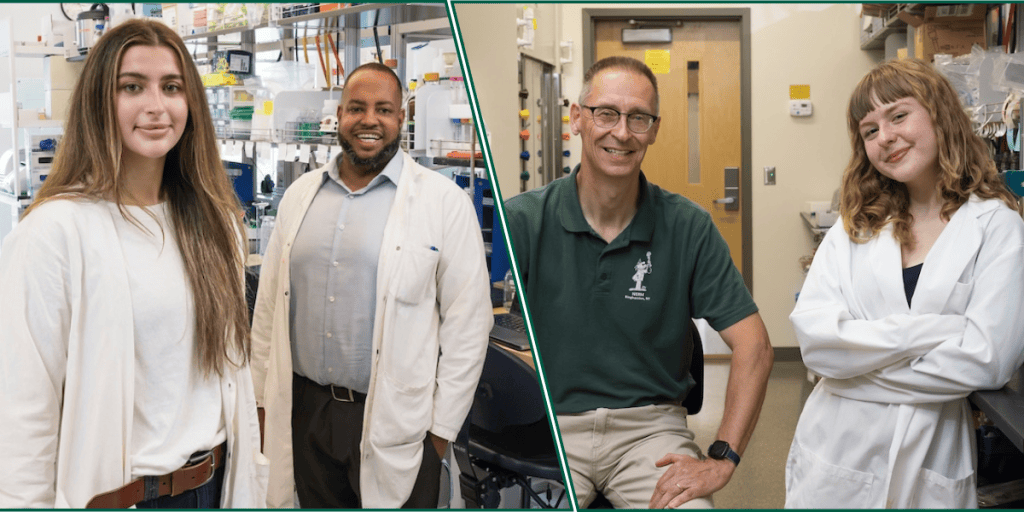
Two Binghamton researchers explore science through national funding opportunity
By Ethan Knox ’20 on SEPTEMBER 29, 2026 @BingUNews
Since 1998, the Beckman Scholars Program has provided financial support to undergraduate scientists in biochemistry, biological sciences, biomedical engineering, chemistry, and integrative neuroscience.
As part of the national, three-year grant sponsored by the Arnold and Mabel Beckman Foundation, participants undergo a 15-month (May 2027 to October 2028) mentored research experience and receive $21,000 to support their development and research endeavors.
Last year, the foundation revamped its criteria and shifted from an invitation-only model to an open call. Binghamton received its first three-year Beckman Scholars award in 2022, then reapplied in 2025. Each round, the External Scholarships and Undergraduate Research Center (ESURC) has partnered with the Office of Strategic Research Initiatives on the application; ESURC then manages the award and annual call for applications for the next pair of Beckman Scholars.
Although Binghamton was a 2025 semifinalist, the University was ultimately not selected for the award, which makes this year’s re-application and acceptance even more celebratory.
OTHER AWARDED SCHOOLS INCLUDE:
- Bowdoin College
- Butler University
- Emory University
- Harvey Mudd College
- Pomona College
- San Jose State University
- St. Olaf College
- Syracuse University
- University of Arkansas
- University of California, Los Angeles
- University of Cincinnati
- University of Maryland, Baltimore County
- University of Pennsylvania
“We were delighted to be re-accepted into the Beckman Scholars program,” said Stephen Ortiz, assistant vice provost for academic enrichment. “A prestigious group of institutions are involved in the program, which speaks to the excellent quality of Binghamton’s faculty and research facilities. More importantly, it provides an unmatched level of support, mentorship, and training to our student award recipients.”
In total, 14 institutions were selected(opens in a new window) after this year’s application process(opens in a new window), which included a two-part review led by a panel of scientific experts and required Binghamton to provide materials from eight to 15 faculty members who fit the criteria and agree to serve as mentors for the duration of the award. Binghamton was the only SUNY school to receive funding this cycle.
Brikena Kukaj, an integrative neuroscience major mentored by Tony Davis, assistant professor of pharmaceutical sciences, and Nino “Nini” Dzotsenidze, a chemistry major mentored by Professor Christof Grewer, chair of the Chemistry Department, were named as this year’s awardees in April 2026 and began their research in May 2026.
PAST BECKMAN WINNERS
Binghamton’s first Beckman Scholars were selected in 2022. In total, eight Binghamton students have been awarded this prestigious honor. In addition to Dzotsenidze and Kukaj, they include:
- Clara Rodriguez (2022-23), Biomedical Engineering major, mentored by Guy German, associate professor and graduate program director of Biomedical Engineering
- Shruti Venkatesh (2022-23), Integrative Neuroscience major, mentored by Chris Bishop, professor/director of undergraduate integrative neuroscience in Psychology
- Fiddi Hilmi (2023-24), Biological Sciences major, mentored by Karin Sauer, distinguished professor of Biological Sciences
- Eric Talbott (2023-24), Chemistry major, mentored by John Swierk, associate professor of Chemistry
- Sarah Groh (2024-25), Chemistry and Environmental Studies double major, mentored by Kirsten Prior, associate professor of Biological Sciences
- Jiaer Huang (2024-25), Integrative Neuroscience major, mentored by Chris Bishop
“Getting into the Beckman program really changed my life,” Dzotsenidze said. “I felt so lucky that I was one of the students they chose, and it gave me a different perspective on research and problem-solving. I think it’s so important to have programs like this, giving students an opportunity in the research world and support along the way.”
Along with being paired with their mentors and working on their projects over two summers and the academic year, the pair also joined one of Binghamton’s 14 Beckman faculty mentors, Tracy Brooks, chair and associate professor of pharmaceutical sciences, in Irvine, California, for the 2026 annual Beckman Symposium(opens in a new window) from July 30 to Aug. 1. This served as an opportunity for the Beckman Scholars from across the country to meet for networking. The pair will round out their 15-month commitment with a second visit to the Beckman Symposium.
Exploring bacterial iron acquisition and engineering proteins to fight disease
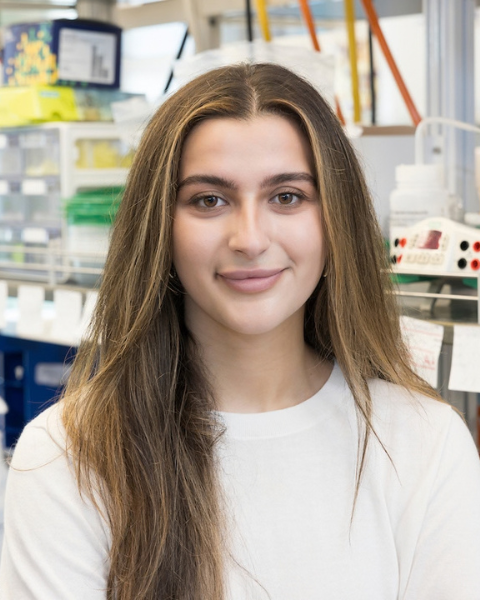
Kukaj always knew she was going to college. As a first-generation student with immigrant parents from Albania, it was seen as a “when,” not an “if.”
But she didn’t feel as if her path was chosen for her; it took her no time at all to fall in love with medicine. It may have been partially thanks to the First-year Research Immersion (FRI) Program, where she joined the neuroscience stream upon her arrival to Binghamton University.
“I’ve always been interested in the brain and how it works. I like the concept of doing research and the final product of it,” she said. “FRI holds a very important place in my heart. I will always underscore the importance of coming in and immediately doing research.”
That experience also guided her on her future path. With her time at FRI under her belt, she became a more confident researcher and realized that she was interested in stepping beyond behavioral neuroscience into a more application-based practice. When she heard about the Beckman Scholars program, she applied; when she was selected, she connected the most with Davis, who followed an educational and career path she might want to emulate.
Together, the pair now study the biosynthesis of yersiniabactin, a small molecule that allows bacteria to capture iron from its surroundings. Iron, which is important in different biological processes, is intentionally kept low within the body, a natural defense mechanism against bacterial infection, which needs that iron to survive. If scientists can better understand this molecule, they can then block it.
But the first step is to remove the biosynthetic enzymes from the cellular “junk,” a complicated method that Kukaj is pioneering — she is the first to use certain instruments and methods for this process within the Davis Lab.
“We’re trying to isolate particular yersiniabactin biosynthetic components and see how they work together,” she said. “I work on expressing and purifying a methyltransferase. The first time we purified it, we saw that it was getting cleaved, so we are trying to optimize that process using mass spectrometry. A real-world application of this is to understand how the parts work together, and instead of killing bacteria in a more traditional pathway, we could interfere with just that specific component of obtaining iron.”
Davis explained biosynthesis as an assembly line, where removing just one part makes a non-functioning product. Each station, though, can also be retooled. Modifying methyltransferases allows chemists to introduce new raw materials and get to useful compounds that could benefit our health.
“Our goal is to use methyltransferases to conduct interesting chemical transformations that are often done with harsh reagents that present environmental and health concerns, especially on a large scale,” Davis said. “The general idea is to engineer these enzymes to accept a much broader range of chemical starting materials than what they were specialized for.”
Beyond the research, Kukaj said that the Beckman Symposium and a second regional conference called the Western New York Structural Biology Symposium gave her important perspectives as well as a new network of like-minded scholars and a newfound passion for the project. She can’t wait to continue her work through the upcoming year.
“I think my favorite part about conferences and going to symposia is when you’re interacting with people that are either outside of your field or outside of your university, you always come back with a million ideas and you’re rejuvenated,” she said. “I always find it very refreshing and exhilarating.”
As the Beckman project continues, Kukaj is also working on defining her future. Since she joined the Davis Lab, she’s begun considering a doctorate, a path she said Davis was the first to encourage.
“He’s seeing what I’m capable of doing in the future and contributing to this field, so it’s been encouraging and helpful to see myself through his different lens,” she said.
Davis noted that Kukaj’s enthusiasm, experience, and willingness to mentor younger students made a path to a PhD an obvious choice. He believes that these opportunities, where students can network, shape — and in some cases redefine — career paths, are some of the most important aspects of a college career.
“One of the best parts of my job is seeing students figure it out, whether they be graduate students or undergraduates, not just in the lab, but also life-wise,” he added. “I’m very excited for what the future holds for Brikena.”
Developing potential cancer therapeutics with protein inhibitors
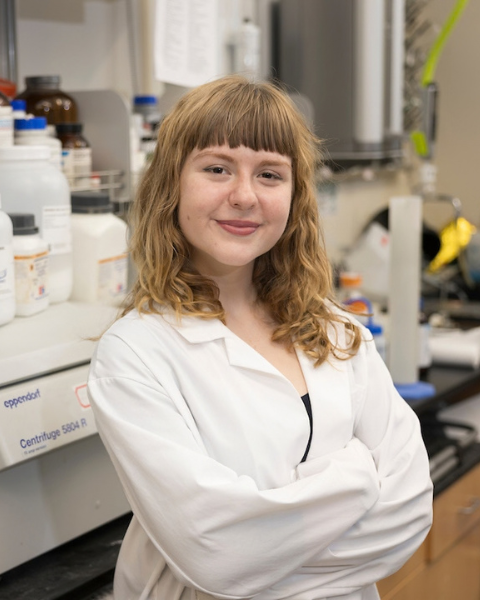
Dzotsenidze, a junior this year, is pursuing a biology track chemistry major with a biomedical engineering minor. Her interests have focused on catalyst design, cancer cell behavior, and protein inhibitor development. She, too, is excited to keep growing as a researcher.
Dzotsenidze’s passion lies mainly in taking on projects that challenge her: originally from the country of Georgia, she initially struggled with the sciences, since she understood very little English. As she worked to translate the material and research the concepts on her own, she found herself increasingly passionate about science, particularly chemistry.
It’s set her on what she sees as a lifelong pursuit in the sciences.
“I constantly try to understand the reasoning behind why each step of a reaction happens and connect that understanding to the experiments and reactions we carry out. Doing this not only helps me think about how our work can be improved, but also allows me to better understand and appreciate the beauty and complexity of the research we do,” she said. “I just feel so much more confident. It’s amazing to connect what we learn in class to the things I do in the lab.”
When she first came to Binghamton, she met Jiye “James” Fang, professor of chemistry, who brought her into the lab as a volunteer. She then applied to Binghamton University Projects for New Undergraduate Researchers (BUPNUR) to do research in a biomedical engineering lab, where she learned the basics of research. She finally applied to Beckman Scholars, where she’s completing more independent hands-on work.
“I wanted to step out of my comfort zone,” Dzotsenidze said. “My priority is to be good at what I do, so I knew that being in the Beckman program would be something that would give me new skills and challenge me so much more.”
As her mentor, Grewer is involved in every step of Dzotsenidze’s project, but her day-to-day work is alongside her graduate advisor, Lindsey Nassimos, who has been working in the Grewer Lab for four years while pursuing her PhD.
Together, the pair work on anti-cancer therapeutics. They focus on a transmembrane protein, which “sits” on a cell and serves as a gate, exchanging things like ions, salts, and amino acids from inside to outside the cell and vice versa. The protein, however, is also known to be overactive in cancer cells, which is a problem, since many of the materials it transports can help a tumor grow. Their goal is to develop a molecular inhibitor that can mimic those amino acids and “turn off” the protein.
“Nini has become the organic synthesis person of the lab, so she will come in as the first person on the project, creating the inhibitors. Then, I do a method called patch clamp, which is how we validate our inhibitors, to see how well they work,” Nassimos said. “Once I have my results, I come back to her, and I say, out of these 10 structures, these two work well. These eight don’t work. Let’s look at these two, see what the similarity is, and continue developing from there.”
Grewer added: “Immediately after joining the lab in May, Nini has hit the ground running, and she is now already working on more complicated organic synthesis reactions. Her motivation and enthusiasm for research are infectious.”
Dzotsenidze has found the Beckman Scholars project an excellent opportunity to ask questions and develop relationships with people like Nassimos
“Going to the conference, I met so many interesting and inspiring people, and I got to hear about all the research that they do,” she said. “It made me feel that now I can take better advantage of this opportunity that I was given, and their passion was so inspiring. It just made me feel lucky to have had the opportunity to be there.”
For now, she’s focusing on the nearer future, but she’s sure the Beckman Scholars project is just the first stop.
“I feel like a PhD program is the right path for me. I am very determined to be in the research world and to wake up every day feeling like I’m contributing to something that could change someone’s life,” she said. “The Beckman Scholars Program has given me an opportunity to get a better understanding of what my future could look like.”


Leave a comment