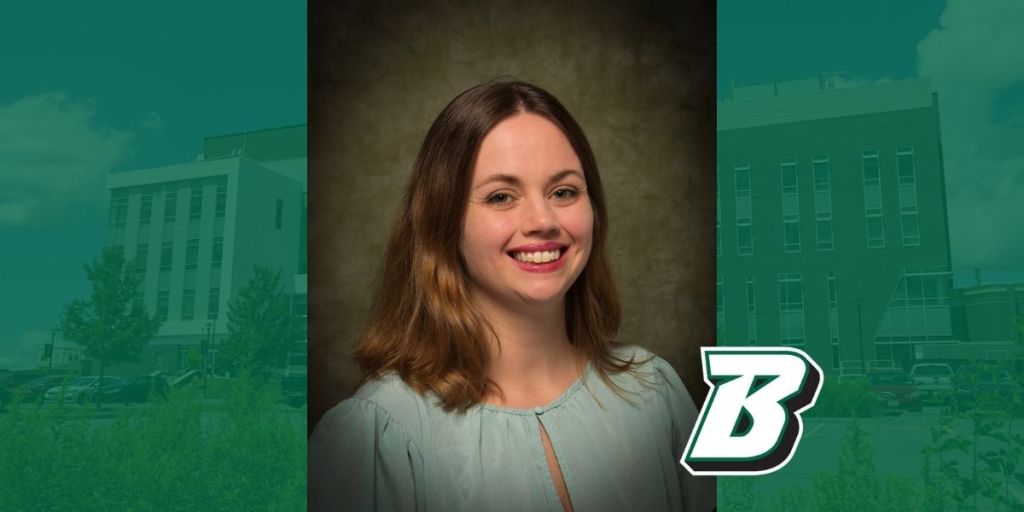
Force brings research expertise and passion for teaching back to SOPPS
By Ethan Knox ’20 on OCTOBER 30, 2026 @BingUNews
For Barbara Force, Binghamton University’s School of Pharmacy and Pharmaceutical Sciences (SOPPS) newest lab manager, returning to the Binghamton area is an opportunity to bring her passion for science, mentorship, and laboratory management back home. After pursuing research nationally, she’s excited to shape Binghamton’s future — one student, one experiment, and one connection at a time.
Read more about Force’s story below!
1. Force discovered Binghamton while attending Cornell University’s College of Agriculture and Life Sciences. In December 2014, while on the way home from a Friday night date, her car broke down in Binghamton, and after making a weekend of it, she instantly fell in love with the area.
Although her first job was at Gilinder Brothers Glass in Port Jervis, New York, where she gave tours of an old glass factory and showed people how glass was made, she ultimately decided to pursue research full-time as a career in 2018. She looked for opportunities in Binghamton because she had loved the area so much; David Jentsch in the Department of Psychology was looking for a research technician who could also manage the laboratory.
The Jentsch Laboratory studies the biological drivers of addiction. Their research seeks to answer how some people who try drugs or alcohol become addicted while others don’t. What contributors might have a genetic component? The lab can paint a fuller picture by looking at things like motivation, impulsiveness, and the likelihood of heavy drug or alcohol use, as well as the brain circuits behind those behaviors.
“While I was working in the Jentsch Lab, I worked closely with then postdoctoral fellow, Jared Bagley. He went on to continue studying NAV1 and the biological drivers of drug addiction. Doctor Bagley was an incredible and patient mentor, and David ran an inclusive and fascinating laboratory. I was lucky to work with them.”
2. She really enjoys mentoring undergraduate students!
She has a particular interest in helping pre-vet students find opportunities to get hands-on research. She also enjoys working with pre-research and pre-med students to teach them the foundations of methodologies and how assays have real-world applications.
“Binghamton University has a complex and diverse student body. I had students who were working full-time keeping the family business alive while also carrying 18 credits of full-time coursework, and I had students who had never done a single chore in their entire lives because they had in-home maids and chefs. I remember staying late on a Friday night to teach one of the latter how to sweep floors. My position was dynamic in that I taught students a little bit of everything — from autoclaves to gel electrophoresis to how to wash dishes.”
Later in her career, she continued training others, though they were farther along in their careers. She taught post-baccalaureate trainees and research assistants, and she appreciated that they could teach her things, too. She helped develop a journal club to expand her horizons and probe the experts in the lab.
3. While working at Binghamton, she fell for a graduate student in the Chemistry Department — Daniel Ciulla (a new faculty member at SOPPS!).
In 2022, Ciulla was offered a prestigious postdoctoral fellowship in Rockville, Maryland, with James Inglese, whose lab develops novel assays for drug research and discovery. Together, the pair moved south.
She eventually found a position at the Henry M. Jackson Foundation, a nonprofit that supports military medical research, as a research associate. There, she worked for the US Military’s HIV Research Program (MHRP), which conducts research needed to develop a successful HIV vaccine for our warfighters, at the Walter Reed Army Institute of Research (WRAIR) at the Silver Spring installation. The research took place at the Forest Glen military base, where she worked with uniformed military personnel and other contractors.
“Disease is still the greatest threat to our military, even if it doesn’t gather the same media attention as other casualties. The broader mission of MHRP is to protect service members from HIV through sexual and blood exposure. The military previously had a modestly effective vaccine in their RV144 clinical trial that was able to reduce HIV acquisition by 31.2%.”
4. She believes upstate New York is the most beautiful place that she’s ever seen, with lakes and waterfalls, fall foliage, massive Halloween spirit, and hard-working people. (She’s also been to restaurants with Michelin star chefs, but her favorite restaurants are here in Binghamton. She’ll “take Basha’s or Tony’s any day!”)
Force has lived in many states, including Ohio, Texas, and Florida. The DC area, in particular, was stressful for Force and her family; the pressures of the area triggered a latent autoimmune disorder, ultimately leading her to change jobs. She also ended up working at the National Center for Advancing Translational Sciences (NCATS), like Ciulla, though in a lab using CRISPR, RNAi, and small-molecule screening to investigate how genes function, contribute to disease, and can be targeted.
“NCATS was an exciting opportunity, and I was fortunate to have the opportunity to work there,” she said. “I was performing a lot of cell culture and lab bench work related to functional genomics. I had amazing mentors who were patient while also holding high standards. NCATS was highly collaborative, so I worked on many fascinating projects with the brightest minds across the National Institutes of Health (NIH).”
One of her most memorable projects focused on culturing i3Neurons, human neurons grown in a dish from stem cells. In i3Neurons, a gene called NGN2 is built into the cells’ DNA and switched on with the drug doxycycline, efficiently converting them into neurons to study and eliminating the need for human brain tissue. These neurons are great models for diseases like Niemann-Pick disease type C (NPC), a rare, inherited neurodegenerative disorder, because the i3N model lets scientists test potential therapies by comparing neurons carrying mutations.
5. She’s a new mother! Their baby girl was born, healthy and strong, in January 2026.
“Our daughter was our biggest motivator to get back home,” she said. “We had been homesick for years. We missed the comforts at home. We were so lucky to find that the School of Pharmacy and Pharmaceutical Sciences was looking for a professor as the SDR assay was taking off. It was Daniel’s dream job — coming home, continuing drug discovery, and bringing home his novel assay.”
Her connection with Bagley came in handy; he suggested that Force apply for the lab manager role, a position she had always wanted to pursue.
“I love teaching students, supporting labs, and working behind the scenes. I had learned a great deal from managing the Functional Genomics Laboratory at NIH, and I’d developed my voice and advocated for myself and others. I wanted to bring that back to the University — to support the academic community that I missed so dearly. I wanted to be back among the students and with professors who loved their science and their jobs.”
6. She doesn’t have words for how grateful that both she and her husband landed their dream jobs.
She describes the people in the School of Pharmacy and Pharmaceutical Sciences as “genuinely kind and brilliant.” Already, the pair are investing in projects within the school and their community.
“I want to make this role the dream job that I envisioned and fill my hours with the things I love the most,” she said. “I want to run crash courses and show students how to do science. I want to cultivate respect from vendors. I want the School of Pharmacy to be treated like the prestigious school it is — and will be. I want to create an avenue for leading technology to come to SOPPS. I also want this to be a safe place to work. The University is so incredibly fortunate to have such a strict and thorough EHS program… A successful year will be one where everyone is safe, mindful, and aware, and we have zero laboratory incidents.”
“I want everyone to feel valued, too. Everyone I’ve talked to at SOPPS has been brilliant, hard-working, and kind. I missed this vibrant community. I missed watching others step in and speak up for the little people. I missed the loving email signatures — ‘My office is a safe space’ — and the artwork on doors and little sketches on whiteboards. There is so much love and respect here, and I can’t wait to help foster that.”


Leave a Reply